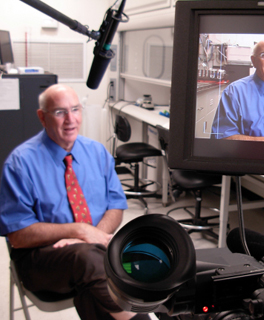

The following are public statements made within the past three years by Dr. Don Catlin or other key people at Anti-Doping Research, Inc.
Dr. Don Catlin issues a call for a meeting to discuss hGH testing (Los Angeles, March 28, 2010):
"An effective test for human growth hormone has been a key priority for many of us working in the field of sports anti-doping. We now have reached a critical juncture, and I invite sports organizations and unions, anti-doping agencies and other science experts to set a meeting to discuss the issues related to hGH testing. We need an open discussion with experts from the National Football League, Major League Baseball, World Anti-Doping Agency, United States Anti-Doping Agency and other concerned agencies regarding where the science stands today and where it’s likely to go. I know that all involved parties, including MLB and their players association, WADA, and scientists such as Peter Sonksen and others, are deeply committed to ridding sport of hGH. Coming together, talking to each other, presenting data, sharing information and pooling resources, we can and will get there. Let’s not hesitate to do so."
Dr. Don Catlin in “MLB takes part in HGH summit,” MLB.com, Nov. 11, 2008
On how his work at ADR is progressing to develop a urine test to detect human growth hormone:
"We're definitely seeing progress. I wish I could tell you we have a growth hormone test today. We don't. I can tell you we have made substantial progress that I am excited about."
Dr. Don Catlin in “HGH test not catching users,” San Francisco Chronicle, Nov. 11, 2008
On leading the efforts to research and develop a urine test for hGH:
"It's a long project, it will take some time, but we're getting somewhere.”
Dr. Don Catlin in “WADA official praises MLB’s anti-doping steps,” USA Today, Nov. 11, 2008
On whether hGH is a performance-enhancing drug:
"To me there is no question (HGH) works. I know you can't prove it, but that's no different than 25 or 30 years ago with anabolic steroids."
Dr. Don Catlin in “MLB won’t be testing for HGH any time soon,” Associated Press, Nov. 11, 2008
On how human growth hormone affects athletic performance:
"There is no answer and I don't think there will be unless somebody gets approval to do the study. It's the same thing with anabolic steroids 25 or 30 years ago. We need the same study with HGH."
Dr. Don Catlin in “Officials Question a Blood Test That Is Never Positive,” New York Times, Nov. 10, 2008
On working to develop a urine test for hGH:
“We have to wait a few years, we are not there in our world. We are trying to find a needle in a haystack.”
Dr. Don Catlin in “Major League Baseball won’t have HGH test in the near future,” New York Daily News, Nov. 10, 2008
On the challenge to develop a urine test to detect hGH:
"Human growth hormone is a huge molecule versus the other substances on the prohibited substances list."
Dr. Don Catlin on “All Things Considered,” National Public Radio, July 10, 2008
On catching cheaters at the Olympics:
“The Olympics and the power and the money behind it is just too big… When you’re up against a problem of this nature and magnitude, those amounts of money (the budgets for WADA and USADA) just can’t do it.”
Dr. Don Catlin in Associated Press article, “Bigger, Stronger, Faster?” June 20, 2008
On doping in thoroughbred racing:
“It’s just exactly like human doping. There’s a lot of horses on them (steroids) and they win and they take them… They’ve been on them for 30 years.”
Dr. Don Catlin in Associated Press story,
“Baseball’s Drug Problem: No Short-term Solutions,” December 17, 2007
On the ongoing race to keep up with athletes using performance-enhancing drugs:
“Let’s say we get that (hGH) contained tomorrow. The next day, there’s going to be another one (drug).”
On the need to keep up with unethical competitors:
“You just don’t hear about the newest things out there because users aren’t going to tell us, and why should they?”
Dr. Don Catlin in Analytical Chemistry, August 1, 2007
On the need for a urine test for human growth hormone use:
“When the Olympics are going on, we will do blood. During the Olympics, everything is focused on a 2-week period, and all kinds of support and facilities are available so we can do blood. But it’s very difficult to do blood day in and day out.”
On the rigors of drug testing in sport:
“When we call a positive case, we have to be exactly on target. We have to have a mass spectrum and retention time. We have to have controls and a lot of details to make sure we can prove our case. We prepare documentation packages that are up to 50-100 pages long, showing what we did and how we did it. There’s a lot of work to prove a positive.”
On the hope of getting athletes to prove themselves clean upfront:
“You want to sit in front of your TV, watch a marathon, and be confident that everyone’s clean. You can’t do that today. I’m wondering if there’s a way to induce a shift so that athletes take charge and clean it up themselves. Many athletes are clean, but they can’t prove it. The whole point of this (new) system is trying to support the athletes who do compete clean and never will cheat.”
Dr. Don Catlin in Analytical Chemistry, June 1, 2007
On his team’s development of a test for synthetic testosterone, which many believed to be unachievable:
“A group of us was sitting around… batting around some ideas. We started saying, ‘Gee whiz, maybe it’s got a different carbon isotope ratio.”
“It was a hard sell. It’s really hard to describe to sports funders what you’re trying to do…
They have no idea what you’re doing. It was ‘Who are you, and how credible are you? You want a $300,000 instrument?’”
On the need to be flexible in developing drug tests, such as the one he and his team developed for the designer steroid, THG:
“There really was no choice (with THG). In this business, if you find something like THG, then it’s out there.”
On his goal to develop a volunteer testing program for athletes:
“We will follow biomarkers much as a doctor would follow a patient by measuring their blood pressure. Some of these biomarkers would be related to doping.”
“What kind of industry is it where you train hard and finally excel to get to the Olympic level, but somebody says, ‘Oh, you must have cheated. How else could you get here?” |